
Trace Medford Previous Residents by Era
Past residents leave different records in different periods. A current parcel card offers a starting owner and parcel key, not an occupancy history. Recorded deeds then identify transfers, while directories and census schedules place names in a household context. Reports, permits, maps, and newspaper notices can explain an address change or a gap. Keep a dated timeline rather than relying on one record type.
| Source | Years It Covers | Where Held | What It Shows |
|---|---|---|---|
| MassLandRecords | Grantor indices 1896-1973; full online cutoff unstated; Books 1-1024 separate | Middlesex South Registry portal or counter | Deed parties, instruments, dates, book/page, and legal descriptions. |
| VGSI / Assessor | Current FY2026 portal; historic-card availability varies | Medford Assessor and VGSI | Current owner, value, parcel, and selected sale or assessment leads. |
| Town and city reports | 1838-present; property-rich years include 1875, 1880, 1885, and 1890 | MHSM PDFs and library | Taxpayer and property descriptions, location, area, and taxes. |
| Directories and voter lists | Library collection 1869-present; annual run varies | Medford Library and MHSM | Published residence, occupation, household notes, and departures. |
| Medford Mercury | 1880-present microfilm | Medford Public Library | Obituaries, notices, address, civic, and business changes. |
| Federal census | Public after the 72-year release rule | Census, NARA, and library databases | Household, age, relationship, birthplace, occupation, and address context. |
| Building records | About 1892-present, according to local house-history material | Building Department, Citizenserve, or records request | Construction, alterations, permit dates, and public applicant or owner clues. |
| Sanborn maps | Circa 1910 hard copy, plus verified sheets in other collections | Library microfilm and MHSM | Building footprint, use, material, and street context. |
The earliest useful starting point depends on the question. For a modern transfer, begin with the parcel and Registry. For a nineteenth-century address, start with a directory street section or property-rich annual report, then bridge to a map and recorded legal description. A past-residents search is stronger when it records what each source can and cannot establish.
Note: A current parcel card establishes a present assessment lead, while each older source supplies a separate dated point on the address timeline.
Start a Medford House Timeline
Begin a Medford address history with the current Assessor and VGSI parcel record. Copy the situs address, owner of record, owner mailing address, Vision ID or account, map or lot key, GIS ID, use, visible sale details, and any book/page reference. The site address is the taxable parcel location. The mailing address is where tax correspondence goes. Neither one identifies all people who were present at the property.
Next, use the city-linked AxisGIS viewer to save the parcel geometry and mapped identifier. Maps help when a street label, lot, or boundary differs from a modern tax address. The live viewer did not expose a stable field list in the research session, so its search labels, popup fields, layer names, and export controls should be checked directly before relying on a particular map feature.
Use one line for each event: source date, event date when separate, name exactly as written, address form, parcel or plan key, and the evidence type. That makes a previous-residents trail easier to correct when a later deed, directory, or map changes the interpretation.
Note: Record execution, recording, publication, and event dates separately because a property transfer or directory entry can appear after a move.
Follow Medford Previous Residents Through Deeds
The Middlesex South Registry index is the recorded-title layer for a Medford address. It offers recorded-land name, document, book, property, and recorded-date searches, plus a separate unindexed-property path for Books 1 through 1024. Recorded-land, registered-land, and plan modes should be treated as separate search paths. Narrow broad results with town, party, date range, and known instrument information because searches may return only the first 1,000 rows.
- Use the current Medford parcel card to copy the owner, map or lot key, and legal-description or sale lead.
- Search the Registry by property when possible. If the address does not work, search the owner or entity with town set to Medford and a narrow date range.
- Open the purchase instrument and preserve the grantor, grantee, recorded date, book/page or document number, plan reference, and legal description.
- Search the transferor from that deed as a prior grantee. Each earlier acquisition supplies the next name or legal-description search key.
- When the chain reaches an older index gap, search Books 1 through 1024 by the unindexed route and ask the Registry counter for older books or images.
The index expressly notes online grantor indices from 1896 through 1973, but it does not state a clean full historical cutoff. A missing result does not prove no deed exists. A person can also appear in a directory before a deed records, and an estate can hold title after a person disappears from an annual listing.
- Grantor and grantee
- The grantor transfers an interest in property; the grantee receives it in the recorded instrument.
- Chain of title
- The sequence of recorded transfers leading backward through the same property interest.
- Legal description
- A deed-defined lot, plan, metes-and-bounds, or unit description that can outlast a street-address change.
- Recorded date
- The date an instrument entered the Registry record, which may differ from its execution or sale date.
Medford Past Residents and Legal Descriptions
An address can disappear from the recorded trail without ending the property trail. Deeds may use a recorded plan, lot, condominium unit, metes-and-bounds description, trustee reference, or party address instead of a current street number. Medford map IDs, Vision IDs, GIS IDs, alternate parcel identifiers, and MBLU-style keys are useful crosswalks, but they are not interchangeable. Copy each one exactly because punctuation and leading zeros may matter.
For a former address, compare the street name and cross street in a directory with a dated atlas, parcel geometry, and the plan or book/page in a deed. A map can show a parcel that shares a boundary but lacks a street number. The legal description and plan reference are the safer bridge. This approach is particularly important when tracking who lived here before through an address that was published differently in a prior era.
Note: An owner mailing address, a directory address, and a tax situs are separate fields and should remain separate in a house-history timeline.
Read Medford Directories by Address
Medford's historical directory layer can supply annual household clues that deeds cannot. The Medford Public Library local-history collection reports city directories and voter lists from 1869 to the present, although the exact annual run varies. The Medford Historical Society directory collection includes selected digitized years and reference-computer access for more years. The collection details belong on the Medford city directory page; the useful step here is moving between a name entry and a street section.
Greenough's 1870-71 volume has both an alphabetical resident section and a street section. Preserve qualifiers such as h. for house, boards, widow notation, West Medford abbreviations, and corner, near, or opposite descriptions. Search the year before and after a match. A new listing, a boarder reference, or a “removed to” destination may clarify a past-residents timeline, but it does not establish an unbroken residence.
Visit the Medford Historical Society directory collection to inspect the searchable directory runs and access notes.
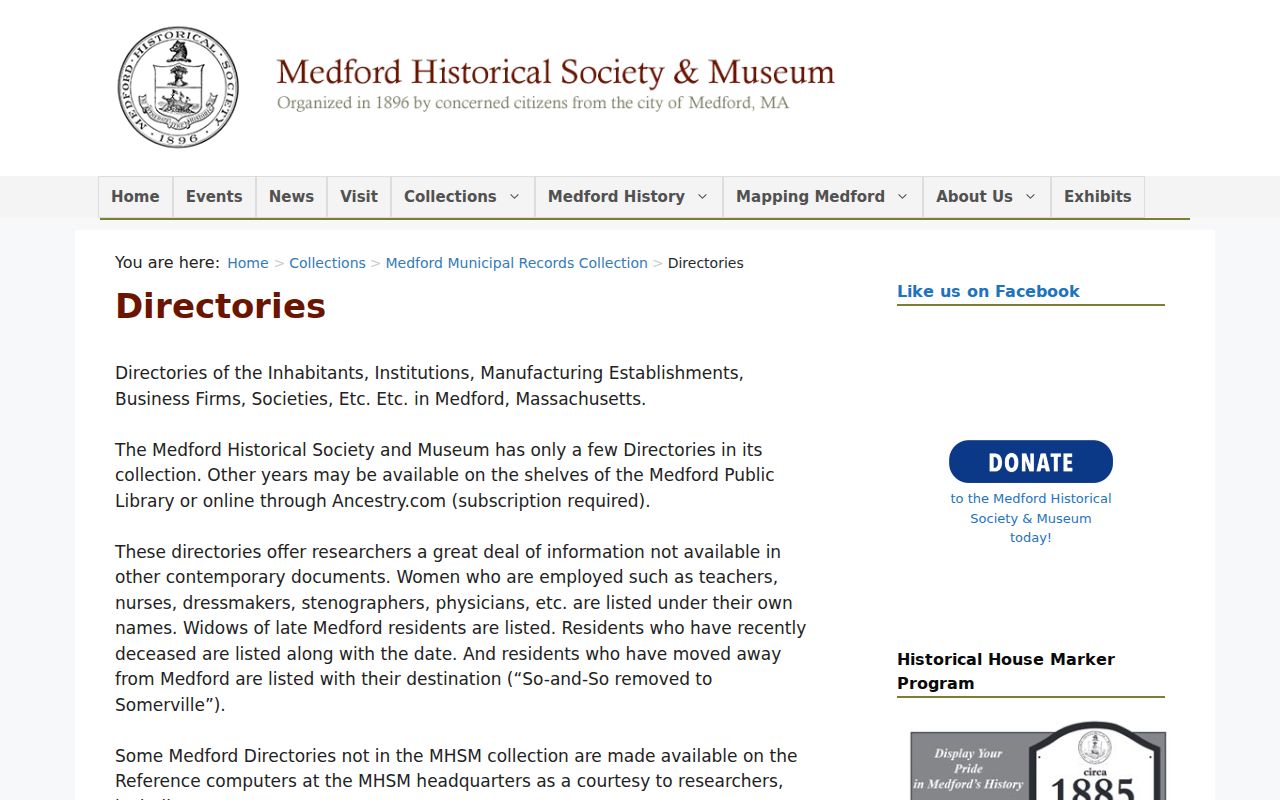
The directory-collection image shows the local source layer used to turn an address or cross street into dated household leads.
Pair Medford Directories and Census
Directories and census schedules answer different questions. A directory offers a published annual address, occupation, and often a relationship or move notation. A public census schedule supplies a household snapshot, age, birthplace, relationship, and address context once the 72-year release rule applies. Enumeration and publication dates can differ, so a mismatch is a reason to compare dates, not a reason to discard one source.
- Find the address or surname in a Medford directory street section and record every spelling, occupation, cross street, spouse or widow notation, and first or last observed year.
- Pair that directory interval with the available federal census year, then compare household members and age context without assuming the records were created on the same day.
- Check Medford town or city reports and poll-tax lists for an assessment clue. Poll-tax inclusion is not evidence of voting.
- Search the Mercury microfilm and its 1890s-1980s newspaper index for death notices, marriage announcements, business changes, probate notices, or a “removed to” clue.
The Medford Mercury microfilm begins in 1880. Its newspaper index gives starting points across the 1890s through the 1980s. A directory disappearance is not proof of death or a move. It may reflect a changed listing rule, spelling, publication timing, or an unsearched address form.
Date Medford Houses With Permits
Permits can place construction and alteration dates beside a previous-residents trail. The Historical Society's house-history material says Medford Building Department records run from about 1892 to the present. The city directs users to Citizenserve through the Building Department for past and present permit searching. Record any public location, permit type, described work, date, status, inspection or certificate link, and applicant or owner field.
Exact online coverage and live search fields were not confirmed. A counter search or records request is the fallback for an older card, application, inspection, certificate, or public owner/applicant field. The name on a permit is a dated role in an administrative record, not proof that the person lived at the address.
Note: Permit material can date construction or alteration work, but it should be paired with deeds and directories before identifying a past household.
Map Historical Medford Addresses
Maps prevent a house-history search from flattening an old address into a modern assumption. The Library and Historical Society have maps and atlases, while the house-history material points to Sanborn maps, including library microfilm and an MHSM hard-copy set from about 1910. Use the Medford Engineering resources with current assessor maps, a dated map, the directory street section, and Registry plan or legal-description references.
No official source verified a citywide Medford street-renumbering year. Do not claim that a particular address was renumbered or renamed without a City Engineer or Clerk map, notice, or recorded evidence. Riverside Avenue is a historical shipbuilding clue, not proof that a current street has the same alignment. Compare the original wording, map date, parcel, and recorded land description before normalizing an address.
The Historical Society's municipal-records project has digitized more than 100 books into searchable PDFs since Spring 2021. Search by street, cross street, occupation, or a neighborhood clue, then inspect the page image because OCR can misread old type or handwriting.
Medford Mercury Departure Clues
A name can leave an address trail for many reasons. The Medford Mercury, local newspaper index, Oak Grove Cemetery office, and probate records can supply a later event or lead. An obituary may name relatives, a newspaper may report a “removed to” destination, and a probate docket can identify an estate role. Use the dated notice to extend the timeline, then compare it with the next directory year and the Registry chain.
Oak Grove Cemetery has no located public online interment search. Use its office by phone, email, or in person for grave-location questions, and use catalogued Library or Historical Society material for local obituary context. Probate files route to the Middlesex Probate and Family Court South Woburn, and some attachments may be restricted. A past resident's absence from one source is not a complete answer.
Limits of Medford Previous Residents
Previous-residents research reconstructs dated evidence, not a complete roster. A current parcel card is not an occupancy history. Property tools do not enumerate everyone at an address, and an owner, permit applicant, directory subject, or estate party is not automatically a resident. Protected voter records, Address Confidentiality Program participation, sealed court files, restricted vital records, motor-vehicle data, and private customer data create intentional gaps.
Lawful personal use. Use Medford house-history and past-residents records for family history, property history, estate research, and civic reference. Do not use a historic or current address trail to stalk, harass, intimidate, or harm anyone.
When a public record is missing, request the responsive record from its custodian rather than trying to rebuild private information. The Massachusetts Public Records Law, M.G.L. c.66 and 950 CMR 32.00 provides the request framework, while Medford's public-records guidance supplies the city route for municipal records.