
Medford City Directory Holdings
Medford's historical directory trail is distributed across library shelves, digitized PDFs, and historical-society reference access. The broadest stated run is the Medford Public Library's City Directories and Voters Lists collection, described as 1869 to the present. That statement does not mean every year is on one shelf or online. The annual run varies, so a missing volume should prompt a request for a different shelf, binder, microfilm reel, or digitized source. The collection table distinguishes directory volumes from supporting records that help explain what an entry means.
| Collection | Years | Where Held | Access |
|---|---|---|---|
| City Directories and Voters Lists | 1869 to present, annual run varies | Medford Public Library local history | Ask reference staff for shelf and microfilm runs |
| Greenough's directory | 1870 to 1871 | Medford Historical Society and Museum | Digitized 143-page PDF |
| Selected MHSM directory scans | 1870, 1885, 1890, 1893, 1895 Blue Book, 1895 to 1896, 1902, 1916, 1918, 1920 | MHSM directory collection | Searchable PDFs and collection page |
| Reference-computer directory run | 1868, 1869, 1872 to 1873, 1874 to 1875, 1876 to 1877, 1878 to 1879, 1880, 1886, 1888 | MHSM and partner access | Courtesy reference computer access |
Use the Medford Public Library local-history collection for the broad local shelf, then compare the result with the Historical Society directory collection. The printed and digitized runs overlap in places but do not replace each other.
Medford Directory Years and Shelves
The library at 111 High Street is the first in-person stop for historical directory volumes, voter lists, maps, atlases, reports, yearbooks, vertical files, and Medford Mercury microfilm. Its posted regular hours are Monday through Thursday from 9 a.m. to 9 p.m. and Friday from 9 a.m. to 6 p.m., with seasonal Saturday hours and Sunday closure. Search the Minuteman catalog with “Medford,” but also ask reference staff about non-catalogued binders, microfilm, newspaper indexing, and surname or street files. A staff request can uncover a useful format that an online catalog title does not reveal.
Several access channels sit beside the physical shelves. Ancestry Library Edition and HeritageQuest access details distinguish the in-library database from the library-card route. Those tools can pair a directory line with census, passenger, military, vital, or digitized-book material. The Medford Historical Society and Museum at 10 Governors Avenue is open Sundays from 1 to 4 p.m. or by appointment, and volunteers can help interpret municipal reports, maps, directories, genealogy, and handwritten taxpayer volumes. Ask about reproduction and download permissions before relying on a scan for publication.
Note: A database search, a shelf volume, and a microfilm page can each cover different years, so record the exact edition used.
Greenough's Medford City Directory
Greenough's 1870 to 1871 volume is a detailed early Medford directory, not a generic regional index. W.A. Greenough Jr. of Boston compiled and published the 143-page book, which covers Malden, Medford, Melrose, and Everett. The printed volume names J.N. Gibbs as its Medford seller and gives a price of one dollar. Its alphabetical entries often combine a name with an occupation, a business connection, a house location, and a relationship note. The back street section supplies a second route into the same evidence.
The digitized Greenough directory is the best place to inspect punctuation, spacing, and the original abbreviation key. OCR can misread old type, especially in narrow columns. A search hit should therefore lead to the page image, not to a copied name alone. Occupations such as gardener, freight agent, manufacturer, and merchant can separate two people with the same surname, while an address near a corner or named facility can confirm the right household.
| Headword | Resident surname and given name, sometimes with a relationship annotation. |
|---|---|
| Occupation or affiliation | A trade, business, organization, or public role that helps distinguish like-named residents. |
| Residence | “h.” means house; the line may also give a street, cross street, corner, or nearby landmark. |
| Boarding clue | “boards” identifies a boarding arrangement and does not establish ownership. |
| Family or movement note | Widow notation, a woman's own entry, or “removed to” can place the name in a household timeline. |
Note: Preserve the printed abbreviation and page number before expanding it, since punctuation and OCR can change the meaning of an entry.
Reading Medford Directory Entries
Read a historical entry as a compact record, not as a modern address label. “W.M.” means West Medford. “Near,” “opposite,” and corner language can be more useful than a house number when a street changed form or when a scan omits punctuation. Widow notation can identify a deceased spouse, and women who worked may appear under their own names. Preserve the wording in research notes, then add a separate plain-language expansion rather than silently replacing the original notation.
- Criss-cross directory
- A street-order listing that lets a researcher move from an address to the people recorded along that street. No separate Medford reverse-directory run was located by title, but the street sections perform part of that task.
- Householder index
- An alphabetical arrangement that starts with a person or household name. It is useful for a first surname pass, but it should be checked against the street section.
- Abbreviation key
- The volume's explanation of shortened words and place references. Photograph or transcribe it before interpreting “h.,” “boards,” “W.M.,” or occupational abbreviations.
- Cross-street clue
- A “near,” “opposite,” or corner reference that can be matched to dated maps when the current street layout is uncertain.
Both directions matter. Search a surname in the alphabetical section, then test the street section for nearby entries, alternate spellings, and an address sequence. Streets in the 1870 to 1871 book include Ashland, Washington, Water, Webster, West, West Albion, William, Winthrop, and Woburn. The method is historical address reading, not a claim that every listed person lived there permanently.
Medford Directory Search Routes
MHSM has digitized more than 100 municipal books since its Spring 2021 project launch. The searchable PDFs accept names, streets, occupations, and other terms, which makes them useful when a surname is misspelled or difficult to read. Search a street, cross street, trade, named school, shipyard reference, “widow,” or “removed to” as well as the name. A result from a scan is an entry point. Verify it on the page image and keep the year, page, and collection name with the note.
The MHSM digitized-directory collection shows the selected directory years and access path.
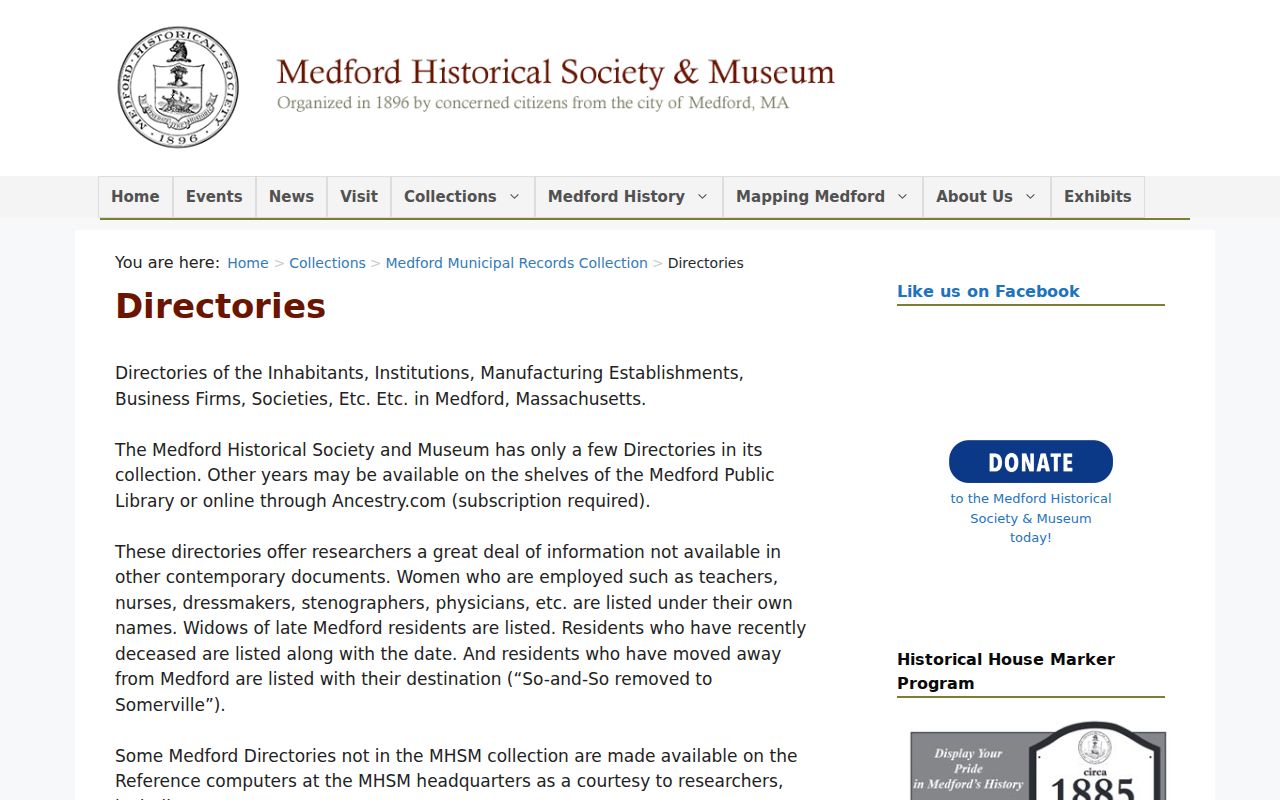
Digitized volumes reduce the first search time, but the library and museum remain necessary when a year is absent, an index is weak, or a physical-page check is needed.
Medford Directory Clues in Mercury
A directory entry is strongest when it is placed beside local reporting. The Medford Mercury is available on library microfilm from 1880 to the present, and the library's newspaper index reaches from the 1890s into the 1980s. Look for obituaries, marriage announcements, business changes, civic notices, and “removed to” notices after finding a household in a directory volume. Those materials can explain an address change or a vanished name without turning a gap into an assumption.
The Medford Historical Register, available for 1898 to 1940, adds biographies, institutions, and local events. High-school yearbooks cover 1915 to the present at the library, while MHSM has digitized yearbooks from 1924 to 2023. These companion sources identify a school or public affiliation in a particular period. They should not be used to infer a current address.
The Massachusetts Archives vital-record index is another companion search for an event that helps explain a change in a Medford city directory line.
The index supplies a citation lead, while the directory volume remains the source for the household's printed address and wording in that year.
Note: A name's disappearance from a directory can reflect a move, death, misspelling, boarding change, or an omitted volume.
Medford City Directory Timeline
Medford's directory evidence sits within a longer municipal record sequence. The timeline helps choose the right companion source for an era rather than treating all resident records as one continuous file. It also marks the practical break between town material and the later city-government record layer.
- 1838: Town and city reports begin in the library and MHSM record trail.
- 1868 and 1869: Additional historical directory years are available through reference-computer access.
- 1870 to 1871: Greenough's regional volume supplies an alphabetical section and a street section for Medford.
- 1892: The city charter transition begins the separate poll-tax list period; women appear in the listed material beginning in 1921.
- Spring 2021: MHSM's municipal-records digitization project begins building a searchable PDF collection of more than 100 books.
Poll-tax lists can support a dated resident or property timeline, but they are not ballot records and do not prove that a person voted. Three handwritten Taxpayers by Street volumes exist at MHSM, yet they are not searchable. Ask the museum about an in-person inspection when an address or surname is likely to appear there.
Medford Maps Behind Directory Addresses
Maps turn the address language in historical directory volumes into a usable location. The library holds maps and atlases from the 17th through 20th centuries, and the historical materials include a hard-copy Sanborn set around 1910. The MHSM house-history brochure points researchers to directories, maps, Sanborn material, municipal records, and registry sources. Use the dated map before assigning a historical cross street to a modern parcel.
Riverside Avenue is a particular Medford caution. Historical sources use that name in river and shipbuilding context, but no official source in the research identified a citywide street-renumbering year. Compare a dated map, the Engineering street list, deeds, and parcel geometry before declaring a historical address equivalent to a current one.
Note: An old cross street or landmark is often safer than a modern house number when matching an historical directory entry to a map.
Tracing Medford City Directories
Follow one household through several directory volumes rather than treating a single line as a complete biography. Begin with a confirmed address or surname, preserve every spelling and relationship clue, and then move outward one directory year at a time. Federal census records offer household composition and age context after the 72-year public-release period. Directory publication and census enumeration occur at different times, so a conflict may be real rather than an error.
- Find the first likely surname or address entry and capture the exact spelling, occupation, spouse or widow note, and cross-street wording.
- Check the directory immediately before and after the target year, marking first appearance, last appearance, boarders, and any “removed to” destination.
- Use the street section to test nearby households and alternate surname readings, especially where a business or boarding address appears.
- Pair the annual sequence with an available census year, then use town or city reports and poll-tax lists to test whether the person was assessed in that period.
- Search the Mercury microfilm and newspaper index for a death notice, marriage, probate notice, business change, or move that explains the next entry.
A disappearance remains an open question until another source explains it. Maps and the house-history material can normalize a cross street, while a deed or cemetery inquiry may provide a later endpoint. Keep publication year, record type, and page citation together so another researcher can distinguish evidence from inference.
Medford Historical Collection Access
The Medford Historical Society and Museum collections gather the broader context around the directory shelf: town reports, genealogy, school records, maps, photographs, military material, municipal PDFs, the Medford Historical Register, *Vital Records of Medford to 1850*, shipbuilding material, and an 1887 manufacturer and merchant directory.
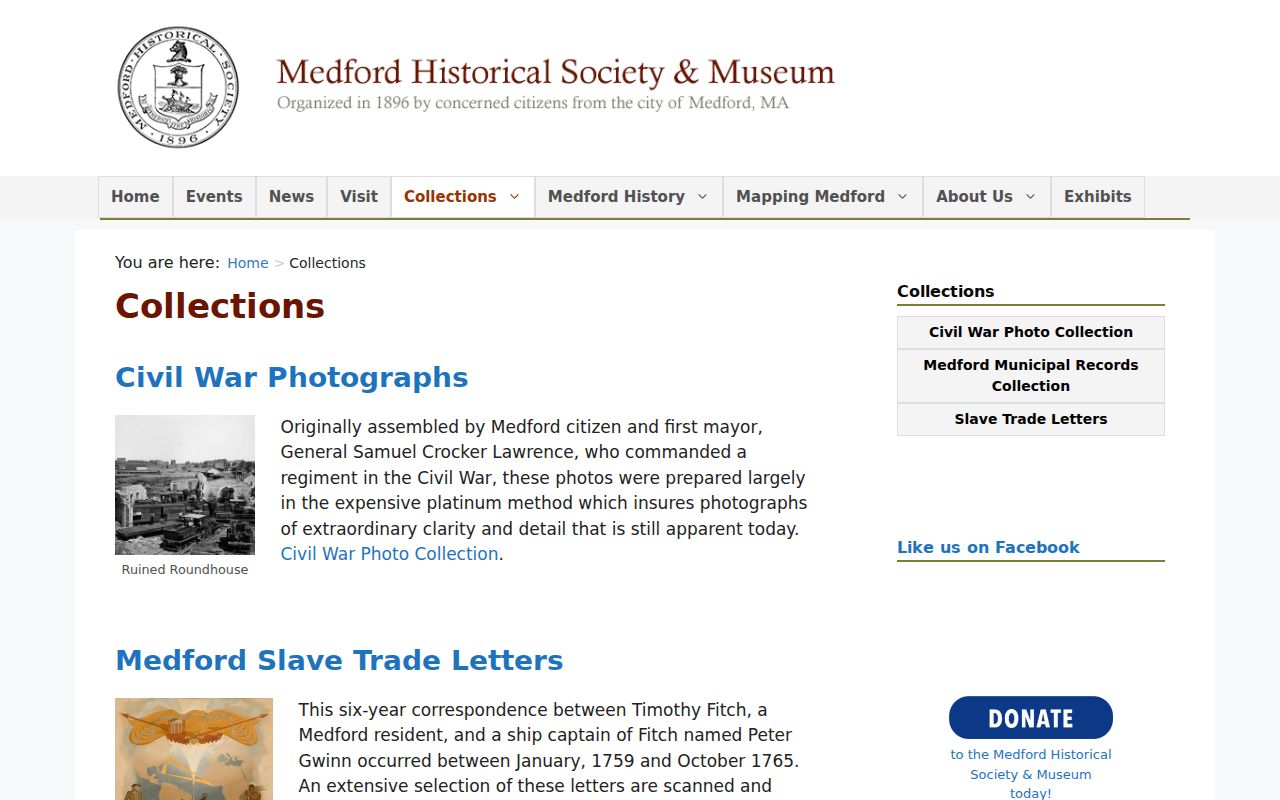
These holdings help interpret a directory line with a local event, institution, or street reference. They are supporting evidence, not a substitute for the original directory page or the public custodian that created a later record.
Medford Directory Limits Today
A historical Medford directory records what a publisher or local compiler printed for a particular edition. It does not prove current occupancy, list every household member, or settle ownership. An owner mailing address, voter registration, directory entry, and property address can each describe different facts. Keep that distinction when reconnecting family lines, studying a street's history, or checking an old business location.
For a present-day address question, use the appropriate current public custodian and preserve the historical volume as a dated source. Privacy protections and restricted records can also produce deliberate gaps. A missing name is not a reason to infer an address or seek private contact information.